Brand strategy · 2026 · 5 min read
CJ Bibigo UK Campaign: Localising Korean Comfort Food for UK Consumers
An FMCG campaign strategy positioning Bibigo ramyun as a healthier, more inclusive, and customisable everyday meal for UK consumers -- built on Sainsbury's field research, consumer insight analysis, and a digital-first Ramyun, Reinvented campaign concept.
- Context
- Self-initiated
- Role
- Solo project -- retail research, consumer insight, campaign strategy
- Duration
- 3 weeks
Frameworks applied
- Retail audit methodology
- Consumer insight framework
- STP (Segmentation, Targeting, Positioning)
- FMCG campaign planning
The brief
Korean food has achieved real mainstream presence in UK grocery retail. CJ's Bibigo brand -- well-established in Korea with genuine crossover appeal -- has a presence on British shelves, but presence and winning are not the same thing. This project asks the harder question: given what UK consumers actually want right now, what would a campaign that earns Bibigo a genuine everyday role in the UK look like?
The project was structured in three stages: retail field research to understand the current landscape, consumer insight analysis to identify the opportunity, and a full campaign concept built from that foundation.
Field research: Sainsbury's Sheffield City Centre
To ground the strategy in what's actually happening at point of sale, I carried out a retail observation at a Sainsbury's supermarket -- one of the UK's largest grocery chains and a key indicator of how Korean food is treated in mainstream British retail.
What I found at the shelf
Limited Korean ramyun variety. Korean ramyun options remain highly restricted in UK retail. Flavour diversity and product range are significantly narrower than in the Korean market, with the category concentrated around a small number of SKUs.
Shin Ramyun dominates. Shin Ramyun shows the strongest presence in both cup and multipack formats, indicating high consumer familiarity and repeat purchase -- but also signalling that the category has effectively been defined by one product, leaving clear white space for a differentiated alternative.
Low shelf visibility. The ramyun section sits inside the World Foods aisle, making it easy to overlook for shoppers not already searching for Asian noodles. The category is not winning footfall; it is waiting for it.
Promotion opportunity. Nectar price-match and membership benefits create a meaningful lever for encouraging trial at launch -- a mechanism that the category has not fully exploited.
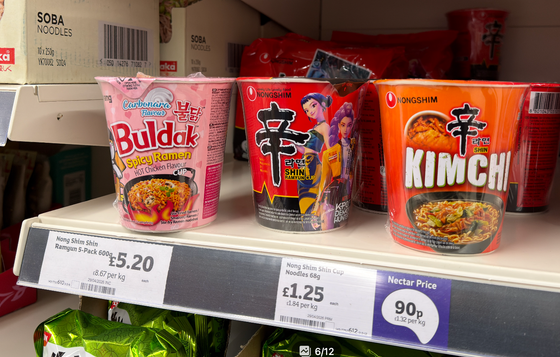
Sainsbury's Sheffield City Centre retail observation: Korean ramyun shelf presence. Shin Ramyun commands the most visible position; overall variety is narrow.
What this tells us
Korean ramyun has growing awareness in the UK, but accessibility, variety, and everyday relevance remain limited. The category's current configuration -- one dominant brand, limited SKU range, low-visibility placement, little-to-no in-aisle communication -- leaves a clear opportunity for a brand that can show up differently.
Consumer insight and opportunity
Cross-referencing the field findings with UK consumer trend data surfaced three unmet needs that the current ramyun category is not addressing.
Healthier and inclusive options. UK consumer demand for vegan, vegetarian, low-calorie, and better-for-you meal options is structurally rising. The current ramyun range does not speak to this -- it reads as a niche, indulgent, spicy product rather than a flexible everyday meal.
Convenient everyday meals. Busy lifestyles among students and young urban professionals drive genuine demand for quick, easy, satisfying meals. Ramyun is structurally well-positioned here -- the format is right -- but the current marketing does not frame it this way.
Approachable Korean comfort food. Curiosity about Korean food is high, driven by K-pop, K-drama, and the broader cultural moment. But many UK consumers find existing ramyun too spicy or intense to adopt as a regular purchase. The category is attracting interest it is not converting.
The opportunity is not to chase Shin Ramyun's positioning. It is to define a new lane: a Bibigo that is healthier, more inclusive, and genuinely customisable -- Korean comfort food that works for UK consumers on their terms.
Campaign strategy: Ramyun, Reinvented
The campaign idea is built around one central move: give UK consumers control over their ramyun experience, starting with spice level and format.
Campaign concept. Position CJ Bibigo ramyun as a light, healthy, and customisable meal solution that fits the diverse lifestyles and taste preferences of UK consumers -- not a niche import, but an everyday comfort food reinvented for a modern British audience.
Product system. The campaign is anchored to a customisable three-step experience: choose your base (mild broth, dietary-friendly noodle options), add a Bibigo low-sugar spicy sauce to control heat level, and make it yours by sharing your combination on social media.
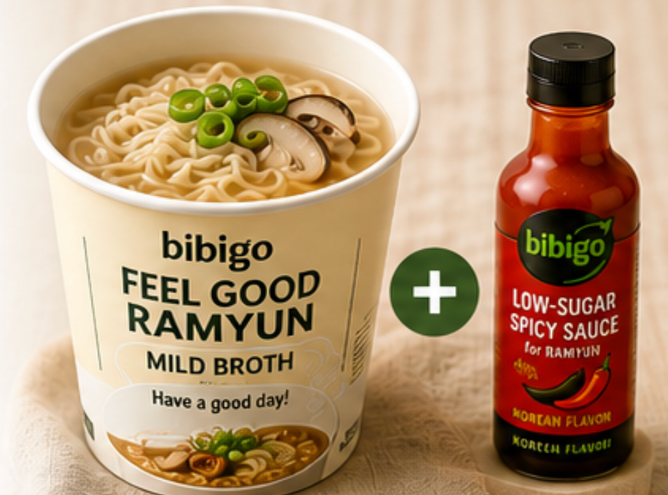
The Ramyun, Reinvented product system: a mild base the consumer customises with Bibigo's low-sugar spicy sauce to their preferred heat level.
Why this works for the UK market. Ramyun, Reinvented aligns with four structural UK trends at once: the health and wellness shift, demand for dietary inclusivity (vegan, gluten-free, allergen-friendly), the convenience moment for students and young professionals, and the momentum behind Korean food culture. It also directly addresses the key barrier the field research identified -- existing ramyun feels too spicy and niche -- by making mild-and-customisable the headline, not a footnote.
Execution plan
Online. A Find Your Ramyun Level social challenge on TikTok and Instagram -- users share their base and sauce combination. Influencer content focused specifically on mild and healthy options, not the heat-challenge format that dominates current Korean food content. Hashtags: #Ramyun_Reinvented and #YourRamyunYourWay. User-generated content showcasing custom creations builds ongoing reach.
Offline. In-store sampling at Sainsbury's and Morrisons comparing mild versus spicy-with-sauce formats -- the fastest way to break down the too-spicy barrier at the moment of consideration. End-cap displays and shelf talkers to increase category visibility beyond the World Foods aisle. Meal combo suggestions pairing ramyun with the Bibigo sauce for upsell.
Launch mechanics. Nectar membership benefits and launch promotions provide a direct incentive to trial at a lower financial risk. Given the field research finding that the Nectar scheme is already active in this aisle, this is an earned, practical lever rather than a speculative one.
What I would do next
The campaign's central assumption -- that UK consumers will respond positively to a mild-and-customisable ramyun format -- deserves real-world testing before scale. I would run a two-store pilot: one with full in-store sampling and end-cap placement, one without. Measuring trial rate, repeat purchase, and basket attachment (ramyun plus sauce) would validate the customisable product system and tell us whether the repositioning is working before committing to a national rollout.