SharkNinja Ninja Blast Vietnam: From Operational Footprint to Consumer Opportunity
A market-entry research challenge for the Ninja Blast portable blender — Korea lead-market review analysis, a Vietnam shelf and channel audit, and a three-gate HCMC pilot design.
2026 · 4 min read
- Client
- SharkNinja · research challenge
- Role
- Solo project — market-entry research
- Duration
- Solo project
- Year
- 2026
The brief
SharkNinja already operates in Ho Chi Minh City — but only as an operational footprint, with no consumer-facing presence. The challenge: can that footprint become a consumer proposition for the Ninja Blast portable blender (BC151)? The answer is built as a five-stage research argument — opportunity, evidence, gap, adaptation, pilot — grounded in Vietnam’s everyday fruit-and-ice drink occasion.
The consumer context sets the bar. PwC Vietnam’s Voice of the Consumer 2025 shows a shopper who is price-led, convenience-dependent and increasingly health-anxious — so value has to be earned through frequent use, not claimed at the shelf.
Evidence: the sinh tố occasion and the Korea signal
Sinh tố — a blended drink of tropical fruit and ice — is an everyday Vietnamese occasion, not a Western import: mango, dragon fruit, pineapple, banana, avocado. The behaviour already exists; the question is whether the product fits it. For that, Korea works as the lead market: the Ninja Blast is already sold there through SharkNinja’s official Naver Brand Store.
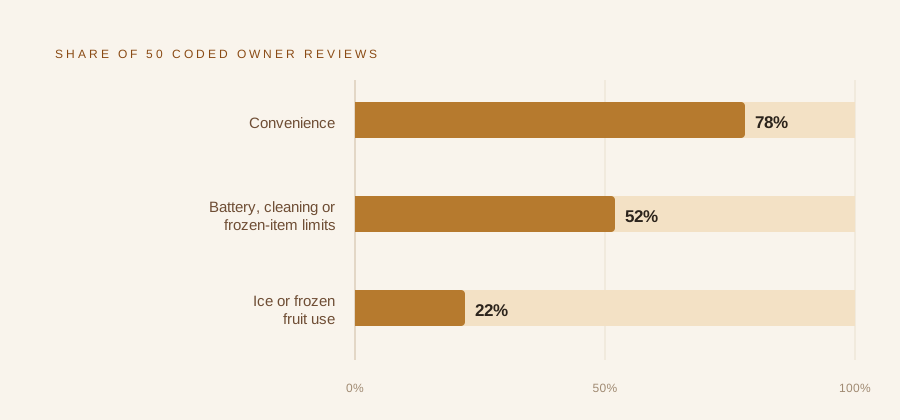
The working hypothesis that falls out of the coding: in Vietnam, convenience may drive trial, while battery life and frozen-ingredient performance may decide whether a daily habit forms — the exact occasion sinh tố demands.
The gap: available, but not trusted
Three audits establish where the product actually stands in Vietnam today.
- Shelf audit — 4 verified listings
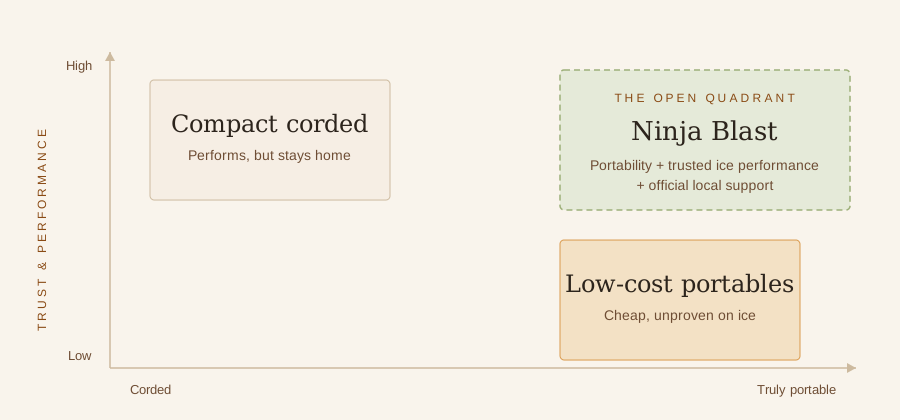
- Ninja Blast reaches Vietnamese consumers only through third-party Shopee sellers at ₫3.4–4.6M — roughly 8–11× the price of local portable blenders, with no official warranty shown.
- Market-status audit — 8 channels
- No official Vietnam consumer site, brand store or local warranty page identified.
- Consumer friction loop
- Wants a fresh drink → thinks about making it at home → faces prep and cleaning friction → defaults to convenience food. Healthy intention doesn’t become a daily habit.
Adaptation: the Vietnam Everyday Kit
Adapt the proposition, not just the product. Each element answers a limitation the reviews actually surfaced.
- Tropical ice performance — validate against mango, dragon fruit, pineapple, avocado, ice and iced coffee; publish a loading guide (liquid first, ice last). Ice is central to the occasion; if performance disappoints, repeat use never forms.
- A battery built for daily use — the product page claims ~15 blends per charge; some owners report 2–5. Set an honest, tested claim for Vietnam, size the battery for one blend a day across a week, and ship a Vietnam wall adapter in-box.
- Cleaning in 30 seconds — cleaning appears in 34% of reviews and the fixed blade is the most common design complaint. Put a quick-clean routine on-pack; treat a detachable blade as the next-iteration design priority.
- Official trust — local price, official warranty and Vietnamese-language support, so everyday value doesn’t depend on grey-market sellers.
Pilot: learn fast in Ho Chi Minh City
Three gates, each with a question that can kill or reshape the proposition before the next tranche of spend.
- Explore · 0–6 weeks
- 8–10 in-depth interviews with urban HCMC sinh tố buyers, 2 focus groups (single-person vs family households), a 5-day beverage diary. Shelf and channel audits already run. Gate: is the need real?
- Test · 6–16 weeks
- In-home use test with 30 households over 2 weeks; concept, price and bundle survey (n = 100–150). Gate: does the adapted product hold up?
- Pilot · 16+ weeks
- Online-first HCMC launch on Shopee, Lazada and TikTok Shop, with official warranty and Vietnamese-language support live from day one. Gate: scale or refine?
Online-first is deliberate: Vietnam’s e-commerce grew 27% in 2024 to a US$32B online retail market — the channel where the Ninja Blast is already, unofficially, being bought.
What I would measure
Purchase intention, cleaning ease, willingness to pay, ice and frozen-fruit satisfaction, bundle preference — and real-world blends per charge, because that is the exact distance between the claim (~15) and owner reality (2–5). If the adapted product does not clear the ice and battery bar, fix it before scaling, not after.