UK Confectionery Market Analysis
A £8.4bn category analysed outside-in — PESTEL, Porter’s Five Forces, STP and a 4Ps strategy for a realistic new entrant.
2025 · 3 min read
- Client
- University of Sheffield · MSc Strategic Marketing & Branding
- Role
- Team project (4) — research and segmentation lead
- Duration
- 10 weeks
- Year
- 2025
The brief
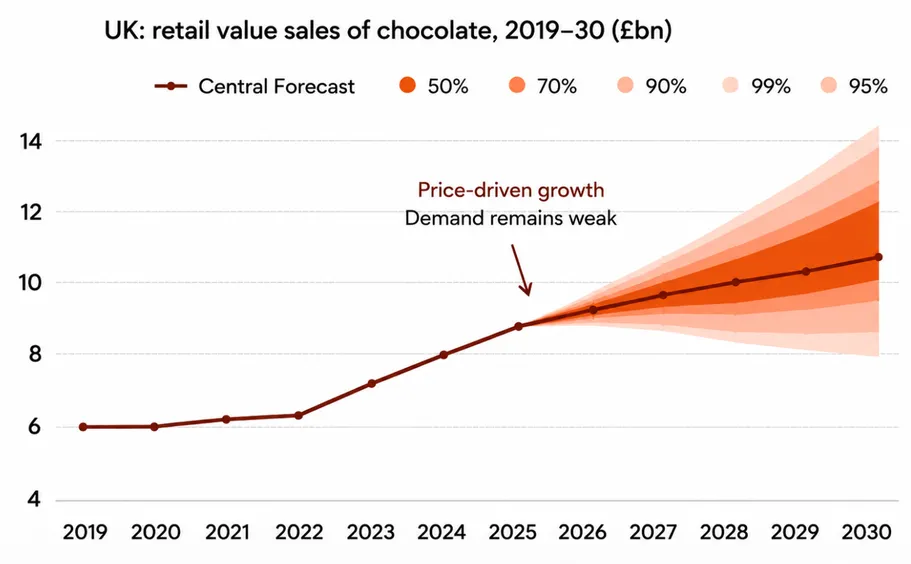
The UK chocolate confectionery market is worth £8.44bn in 2025, up 10% year on year — but that growth is price-led, not volume demand (forecast £10.3bn by 2030, with consumers buying less frequently and spending more carefully). Recommend a positioning and full marketing mix for a hypothetical new entrant — but the harder question: who is the realistic first customer for a confectionery brand launching today?
Method
Outside-in. PESTEL surfaced two structural shifts that mattered: post-pandemic premiumisation of small everyday treats, and the rise of “permission” snacking (deserved-rather-than-allowed). Porter’s showed harsh economics: high buyer power (retailers control shelf), low supplier power, rising substitutes — so the only durable defence is a differentiated brand position.
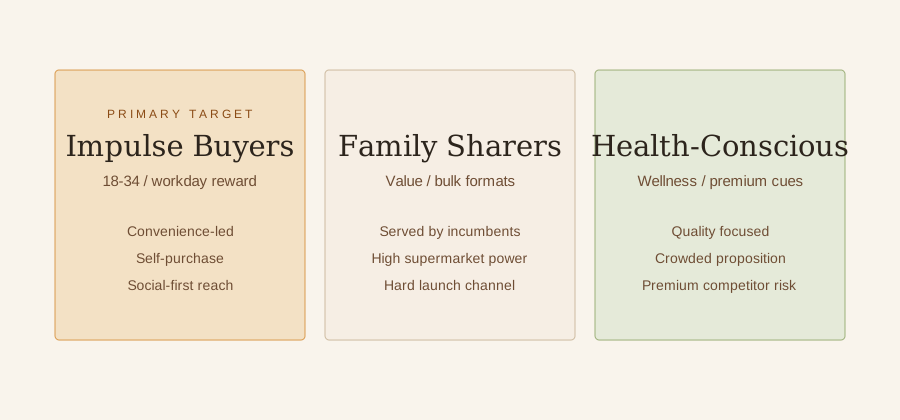
STP (Mintel / Statista / Innova) gave three segments along life-stage, occasion and motivation — and we chose the smallest of the three.
- Impulse buyers (18–34)
- Convenience-driven, self-purchase, emotional reward on the go — the primary target.
- Family sharers
- Sharing and value; bulk purchase.
- Health-conscious
- Wellness and quality; premium / dark.
Why impulse buyers, not the bigger segments
Families and premium buyers are already well-served by incumbents (Cadbury, Lindt) with huge distribution and budgets — unwinnable for a new entrant at launch scale. The 18–34 impulse segment is smaller but structurally different: its occasion is the workday (afternoon dip, Friday celebration, post-meeting reward), won at convenience-format retail and online subscription, not the supermarket main aisle — which changes the competitive set and the channels that matter.
“Healthier indulgence” — the positioning
A treat that takes the guilt out without taking the indulgence out.
Deliberately narrow: it rules out “healthy snacks” (too clinical) and “better-for-you chocolate” (too generic). The wedge is the office worker who wants a 3pm reward without the self-criticism that follows a Twix.
The 4Ps
- Product
- A small, intentionally limited range — three SKUs, measured sugar, recognisable ingredients, single-occasion portion.
- Price
- Premium to mainstream (so “permission” reads as earned), below luxury (so it reads everyday-affordable).
- Place
- Convenience-led — office-adjacent retail (Pret, Boots, WHSmith), Deliveroo / Uber Eats, a thin online subscription tier; not the supermarket main aisle.
- Promotion
- Content-led, social-first, focused on the workday occasion; “earned,” not “healthy,” as the headline.
Strategic recommendation
| Focus | Insight | Strategy | Expected impact |
|---|---|---|---|
| Digital-first reach | Buying less frequently in a value-conscious market | TikTok / Instagram content, influencer partnerships on the afternoon occasion | Increase impulse conversion |
| Affordable formats | Value-driven behaviour rising; managing indulgence, not abandoning it | Small-pack SKUs at a tighter-budget price point | Maintain purchase frequency |
| Better-for-you positioning | Still want affordable, convenient indulgence — but to feel good about it | Functional / wellness innovation around the “earned treat” | Strengthen brand preference & premium perception |
What I would test first
The whole strategy rests on one assumption — that the office-worker afternoon occasion is large enough and exclusive enough to convenience channels to support a launch. A two-city pilot (one with full convenience distribution, one without) would resolve it in three months.